
Why Asking Questions Matters in Nutritional Therapy
“I don’t fully understand what’s causing this.”
It’s one of the most useful things you can say in a nutrition consultation. It’s also something many people find surprisingly difficult to say out loud.
We’re used to sitting opposite a professional, listening carefully, nodding, taking the plan home and doing our best to follow it. Sometimes we understand exactly why we’re doing what we’re doing. Other times, parts of it remain unclear. Perhaps a recommendation doesn’t quite make sense, feels unrealistic, or contradicts something we’ve read elsewhere. Perhaps we already know that it simply isn’t going to fit into the reality of our lives.
But we nod anyway. And often, the parts we never really understood are the first ones to quietly disappear a week or two later.
Understanding your plan matters
I don’t want someone to eat a protein-rich breakfast simply because I told them to. I want them to understand why we’re changing breakfast in the first place and what we hope it might change for them.
We might be thinking about energy through the morning, appetite later in the day, blood sugar regulation, muscle health or simply making breakfast substantial enough to carry them through a busy morning. The reason won’t be the same for everyone.
The same applies when we talk about meal timing, fibre, caffeine, movement, sleep or stress. Without context, these things can quickly become another collection of health rules: eat this, avoid that, do more of this, do less of that.
There are already enough rules around food and health.
I would much rather you understand why we are focusing on something, how it might relate to the symptoms you’re experiencing, and what we are hoping to learn by changing it.
Your experience is part of the clinical picture
I can bring nutrition science, physiology and clinical reasoning into the consultation. I can explain what we know about blood sugar regulation, nutrient status, digestion, the gut-brain axis or the ways prolonged stress can influence the body.
But I don’t live in your body, and I don’t live your life.
You know that your bloating tends to be worse after lunch than breakfast. You know that your energy crashes after certain kinds of days. You know that the breakfast suggestion that looks perfectly manageable on paper is never going to happen because mornings in your house involve finding school shoes, packing lunches and getting everyone out of the door.
You also know what you’ve tried before, what made you feel better, what made you feel worse, what you can afford, what you enjoy eating and what you realistically have the capacity to change right now.
Those things aren’t inconvenient details getting in the way of the “ideal” nutrition plan. They are part of the clinical picture.
A recommendation can make perfect sense physiologically and still be the wrong recommendation for the person sitting in front of me.
When something doesn’t work, tell me
There’s another sentence I wish people felt more comfortable saying at a follow-up consultation:
“I tried it, but I don’t think it helped.”
That is useful information.
It might mean we need more time. It might mean we need to change the amount, frequency or approach. Perhaps something else was happening at the same time that affected how you felt. Perhaps we tried to change too much at once. Or perhaps we need to reconsider what we thought was contributing to the problem.
The same applies if you didn’t manage to follow a recommendation at all. I’m much more interested in understanding why than in measuring how well you followed your plan.
Health happens in the middle of work, children, relationships, finances, disrupted sleep, holidays, stressful weeks and unexpected Tuesdays. A plan has to be able to exist there too.
If something repeatedly doesn’t fit into your life, that is something we need to know.
It’s okay to question what you’re told
Nutrition has become an extraordinarily noisy space. You can leave a consultation, open Instagram that evening and immediately find someone telling you the exact opposite of what we’ve just discussed.
Maybe you’ve heard that a food I suggested is inflammatory. Perhaps a podcast convinced you that you need a particular test or supplement. Maybe your friend removed an entire food group and feels wonderful, and you’re wondering why I haven’t suggested the same thing.
Bring those questions with you.
I would much rather we talk about something than have you quietly wondering whether what I’ve told you is wrong. Sometimes I’ll explain why I see it differently. Sometimes there will be reasonable arguments on both sides. Sometimes your question might lead us to explore something further.
And sometimes the most accurate answer will simply be that we don’t know yet.
There should be room for uncertainty in healthcare. Symptoms can have many possible contributors, and not every question is answered in a first consultation. Good clinical work isn’t about pretending to have certainty where it doesn’t exist. It’s about gathering the information we have, deciding where it makes sense to begin, observing what happens and adjusting as we learn more.
Nutritional therapy should be a conversation
Education is a structured part of every consultation I run, but I never want it to feel like a lecture.
I don’t want you to leave simply knowing what I know. I want you to leave understanding a little more about you.
Over time, that might mean beginning to recognise your own patterns. You notice what happens when meals become irregular, when sleep has been poor for several nights or when stress has been unusually high. You understand why we’ve added something to your meals rather than simply remembering that it was written on your plan.
Because ultimately, the goal isn’t perfect compliance.
I don’t want nutritional therapy to become another set of rules you feel you have to get right. I want it to give you a better understanding of your body, a clearer sense of what supports you, and the confidence to make decisions about your health outside the consultation room.
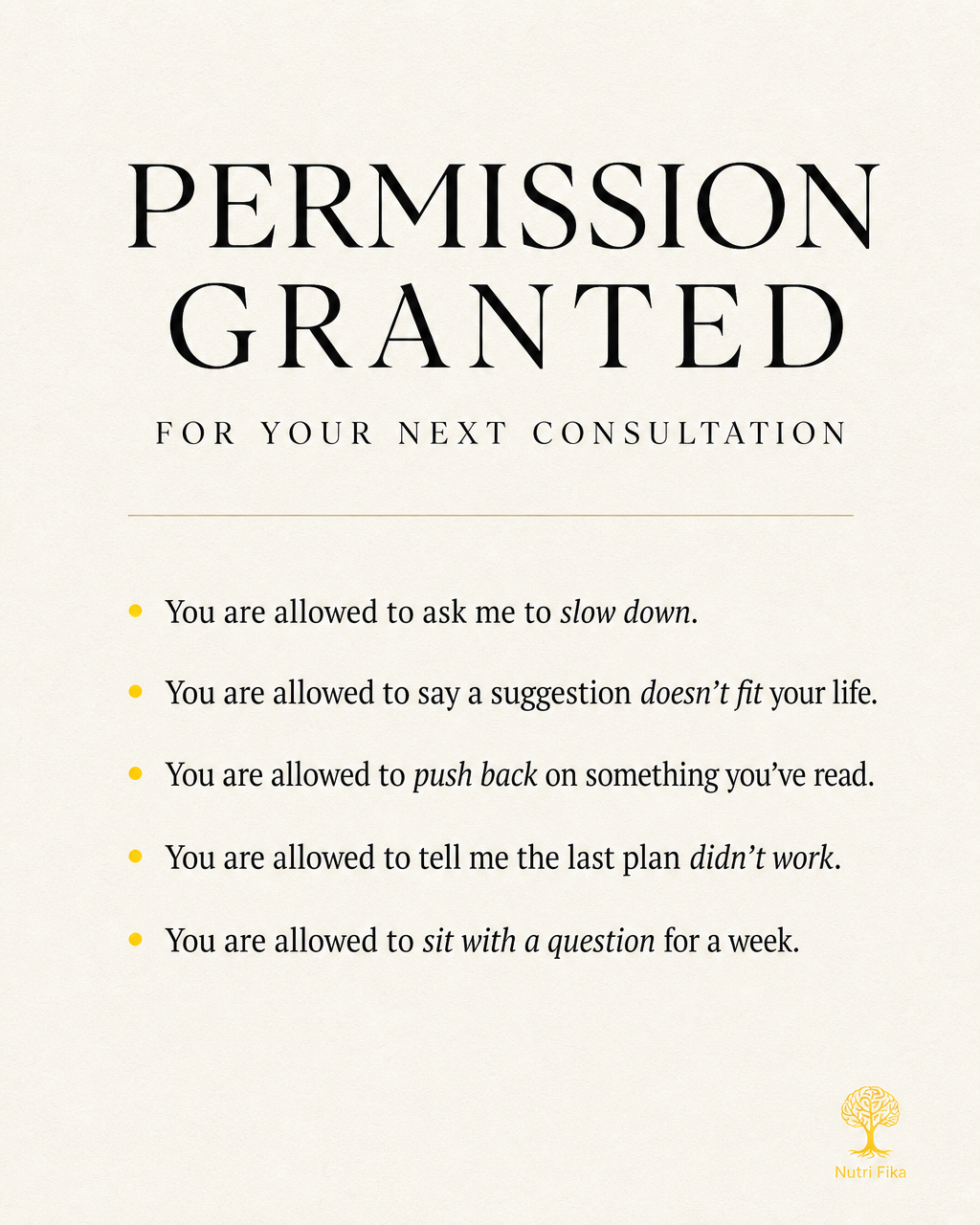
So ask me to slow down. Ask me why. Tell me when a suggestion doesn’t fit your life, your budget or your kitchen. Tell me when something you’ve read contradicts what I’ve said. And when we meet again, tell me what actually happened, rather than what you think I want to hear.
You can come back with the question that only occurred to you on the drive home. You can tell me something didn’t work. You can change your mind.
You don’t need to simply nod along.
Nutritional therapy works best when it’s something we do together.
